

Hire A Top Class Real Estate Agent Who Will Invest In Your Future
January 2026 Economic Update: What It Means for Ontario Real Estate (Buyers + Sellers)
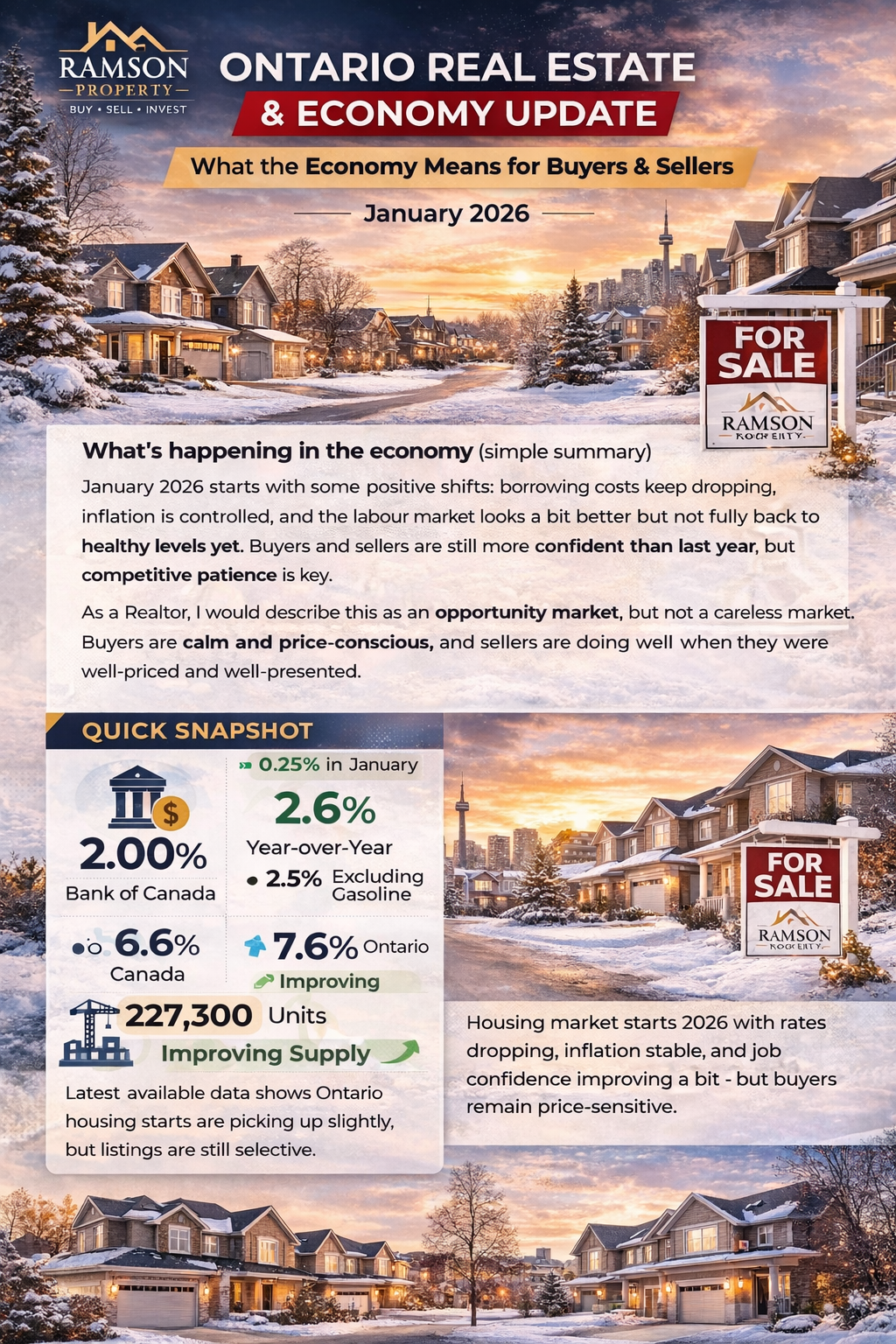
January 2026 Ontario Real Estate Update: What the Economy Means for Buyers and Sellers
By Hardeep Kumar | Ramson Property | Ontario Realtor
What’s happening in the economy?
January 2026 started with a mixed but useful setup for real estate in Ontario. The Bank of Canada held its overnight rate at 2.25% on January 28, which means borrowing costs are much lower than the peak-rate period, but the Bank is still being cautious.
Inflation also cooled a bit. Statistics Canada reported Canada’s CPI rose 2.3% year over year in January (down from 2.4% in December), while CPI excluding gasoline was 3.0%. That tells us headline inflation improved, but some cost pressure is still there in day-to-day life.
The labour market data was mixed. Canada’s unemployment rate fell to 6.5% in January, but StatsCan noted this was largely because fewer people were actively looking for work. Ontario specifically saw employment drop by 67,000, while the unemployment rate still fell to 7.3% as participation declined.
For housing supply, CMHC reported January housing starts (monthly SAAR) at 238,049 units, down 15% from December, while the six-month trend eased to 254,794. Actual starts in centres of 10,000+ population were 16,088, up 1% year over year. This means supply is still being added, but momentum is not strong.
Quick snapshot
-
Bank of Canada overnight rate (Jan 28, 2026): 2.25%
-
Canada CPI inflation (January 2026): 2.3% year over year
-
CPI excluding gasoline (January 2026): 3.0% year over year
-
Canada unemployment rate (January 2026): 6.5%
-
Ontario unemployment rate (January 2026): 7.3%
-
Canada housing starts SAAR (January 2026): 238,049 units
What it means for Ontario real estate (my take)?
Ontario resale activity started the year slower. OREA/CREA board statistics show 7,737 residential sales in Ontario in January 2026, down 15.6% year over year, with the provincial average resale price at $778,102 (down 6.4% year over year).
At the same time, supply is not “low” in the way many buyers remember from hot-market years. Ontario had 24,111 new listings in January and 46,714 active listings at month-end. Months of inventory increased to 6.0 (from 4.7 a year earlier), which signals a more balanced-to-buyer-friendly environment in many pockets.
If we calculate a simple Ontario sales-to-new-listings ratio (SNLR) using 7,737 sales divided by 24,111 new listings, the result is about 32.1%. That is a softer ratio and supports what many people are feeling on the ground: buyers are more selective, and sellers need a sharper plan.
Nationally, CREA also reported a slow January start, with home sales down 5.8% month over month and the national SNLR dropping to 45% (from 51.3% at the end of 2025). CREA specifically noted that Central and Southwestern Ontario were less active and suggested severe winter weather likely affected both demand and supply in January.
So my take for Ontario is this: this is not a panic market, and it is not a blind bidding market either. It is a strategy market. Buyers have more room to compare, negotiate, and protect themselves with conditions. Sellers can still win, but only if pricing, presentation, and timing are done properly.
Buyer strategy (what I’d do this month)
If I were buying in January-style conditions (and going into spring 2026), this is how I would approach it:
-
Start with a fresh pre-approval and payment comfort check.
Rates are lower than the peak cycle, but affordability is still tight for many households. I would set my “comfortable payment” first, then shop below the max approval. -
Use market softness to negotiate smartly.
With Ontario inventory higher and sales slower year over year, buyers may have more leverage than they think, especially on listings with longer time on market or weaker presentation. -
Keep financing and inspection protection where needed.
In a more selective market, conditions are not a weakness. They are a risk-management tool, especially when buyers are trying to stay disciplined with budget and repairs. -
Compare total monthly cost, not just purchase price.
I always tell buyers to compare mortgage payment, property tax, utilities, condo fees (if any), and expected maintenance. A cheaper purchase price is not always the cheaper ownership option. -
Think 3–5 years, not just this month.
Trying to perfectly time the lowest point can backfire. If the property fits your lifestyle, commute, and budget, and you buy at a fair price, that is usually a stronger long-term decision than waiting for a perfect headline.
Seller strategy (how to win this month)
If I were selling in this market, I would focus on execution from Day 1:
-
Price from current competition, not from old peak expectations.
Ontario average pricing is down year over year, and buyers have more listings to compare. Overpricing is costing sellers time and leverage. -
Make the first 7–10 days count.
Professional photos, staging, lighting, and strong listing remarks matter more in a market where buyers are slower and more selective. -
Be ready for negotiation.
This includes price, closing date, inclusions, and conditions. I would plan my “yes / maybe / no” list before the first showing. -
Remove avoidable objections.
Small repairs, paint touch-ups, decluttering, and a clean home can make a big difference in buyer confidence and offer quality. -
Watch the local data weekly, not just monthly.
Ontario-wide averages are helpful, but your result depends on your street, your home type, and your competition this week. Local strategy beats generic strategy.
My bottom line
In January 2026, Ontario real estate looked slower and more selective, but also more strategic for serious buyers and sellers. The key theme is balance: lower rates than peak levels, softer inflation, mixed job confidence, and higher resale supply than last year.
For buyers, this can be a good market to negotiate carefully and buy with protection.
For sellers, this is a market where smart pricing and strong presentation can still produce excellent results.
If you’re planning to buy or sell in Brampton, Cambridge, Kitchener, Waterloo, or Guelph, message me and I’ll help you build a local strategy based on your budget and timeline.
Hardeep Kumar | Ramson Property